Your Dadi Knew What She Was Doing: The Quiet Wellness Revolution Happening in Desi America
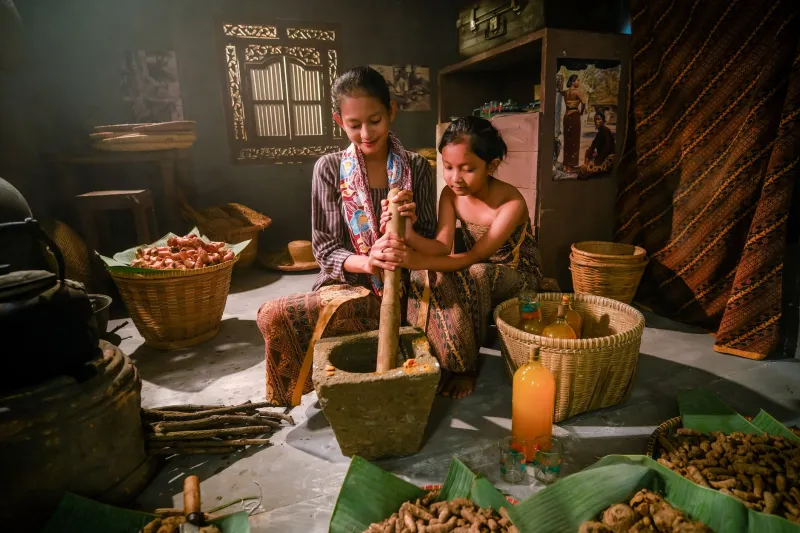
Let's be honest about something: the moment turmeric got a rebrand as a "golden milk latte" and started showing up at Whole Foods for $7.99 a bottle, a lot of South Asian Americans felt something between amusement and low-key rage.
Because turmeric — haldi — wasn't a wellness trend in our grandmothers' kitchens. It was just Tuesday. It was what you put on a cut. What went into the dal. What got rubbed on your face before a wedding. It wasn't a product. It was just life.
That commodification moment was clarifying for a lot of people. It drew a sharp line between the wellness industry's version of South Asian healing traditions and the actual living practices that have been passed down through families for generations. And it sparked something: a quiet, decentralized, deeply personal movement to reclaim those practices — not for the wellness market, but for the community itself.
The Problem With "Wellness" as We Know It
The American wellness industry is worth over a trillion dollars. It is also, in the words of Deepa Iyer, an Ayurvedic practitioner and community herbalist based in the Bay Area, "extraordinarily good at taking something sacred and making it a SKU."
Deep breathwork becomes a $40 class. Ashwagandha becomes a gummy supplement with a millennial-pink label. Neem, which South Asian families have used for oral hygiene, skincare, and pest control for literally thousands of years, gets "discovered" by a skincare brand and sold back at a 900% markup.
"What bothers me isn't that people are using these things," Deepa says. "It's that the knowledge gets stripped out. The context disappears. You end up with a product that's been divorced from the philosophy and the practice that gave it meaning."
Ayurveda, for instance, is not a collection of herbal supplements. It is an entire system of understanding the body — its constitutions, its relationship to seasons and environment, the role of digestion, sleep, and emotional state in physical health. You can't bottle that. But the wellness industry keeps trying.
Reclaiming the Kitchen as a Healing Space
For many South Asian Americans, the counter-movement hasn't required a manifesto or an Instagram account. It's happened in kitchens.
Nadia Rahman, a 34-year-old Bangladeshi American nurse in Atlanta, started calling her grandmother in Dhaka more regularly during the pandemic — partly out of loneliness, partly because the Western medical system she worked in felt increasingly inadequate to address the kind of holistic suffering she was seeing in patients.
"My nani started walking me through things she'd always done," Nadia says. "Specific spice combinations for inflammation. How to make a mustard oil compress. Breathing practices tied to specific times of day. None of it was framed as 'wellness.' It was just what you do when you're not feeling right."
Nadia now hosts informal sessions at her home in Atlanta — she calls them "kitchen circles" — where she shares what she's learned with other South Asian American women in her community. There's no charge, no branding, and a strict no-screenshots policy in the group chat.
"I'm not trying to build a business," she says plainly. "I'm trying to make sure this doesn't get lost."
The Gatekeeping Question
Here's where it gets complicated — and worth sitting with.
There is a genuine tension in this movement between accessibility and protection. On one hand, diaspora youth who grew up disconnected from their ancestral cultures deserve access to these practices. On the other hand, the pipeline from "making something accessible" to "making something a product" is distressingly short in America.
Deepa Iyer thinks about this constantly. She offers sliding-scale Ayurvedic consultations specifically for South Asian clients, and she's deliberate about how she communicates publicly.
"I share a lot," she says, "but I'm also thoughtful about what I share and how. Some practices have ceremonial or spiritual dimensions that don't translate well to a blog post. Context matters enormously. A practice taken out of its philosophical context isn't just diluted — it can actually be harmful."
This isn't about being exclusionary. It's about honoring the integrity of traditions that have survived colonization, migration, and now commodification — and recognizing that survival required intentional transmission, not mass distribution.
The Gen-Z Desi Approach: Skeptical of Everything, Open to Something
Younger South Asian Americans are navigating this with a particular kind of pragmatic skepticism. They've grown up watching both sides of the cultural appropriation conversation play out online. They're wary of their parents' "just drink the haldi doodh" approach to every ailment, and equally wary of a $200 Ayurvedic consultation from a non-South-Asian practitioner who did a weekend certification course in Sedona.
Rohan Nair, 26, a grad student in Chicago, describes his relationship to traditional wellness practices as "curious but cautious."
"I got really into oil pulling for a while," he says, referring to the ancient practice of swishing sesame or coconut oil in the mouth for oral health. "Then I mentioned it to my mom and she was like, 'Yes, obviously, your grandfather did that every morning.' And I felt kind of embarrassed that I'd read about it in a wellness newsletter instead of just asking my family."
That embarrassment — and the subsequent conversation with his mother — opened up something. He started asking more questions. His mom started sharing more. It turned out she had a whole system of seasonal eating practices she'd quietly maintained her entire life without ever labeling it as Ayurveda.
"She just thought of it as common sense," Rohan says. "Which I think is actually the point."
What This Movement Actually Looks Like
There's no headquarters. No app. No conference. The South Asian wellness reclamation happening right now looks like:
A WhatsApp group where Gujarati aunties share home remedy formulations. A Tamil American herbalist in New Jersey who offers community education workshops at the local temple. A Pakistani American therapist who integrates Sufi concepts of the self into her clinical practice. A second-generation Indian American nutritionist who structures her entire practice around the six Ayurvedic tastes rather than macros.
It looks like Nadia's kitchen circles in Atlanta and Deepa's sliding-scale consultations in Oakland. It looks like a 22-year-old calling her dadi on FaceTime and writing down what she says.
It is, in the most literal sense, a practice of inheritance. And unlike a $7.99 golden milk latte, it's not for sale.
"Our ancestors figured out how to keep themselves healthy across thousands of years and multiple continents," Deepa says. "The least we can do is pay attention."