Swipe Right, Hide App: How Desi Gen-Z Is Quietly Rewriting the Rules of Romance
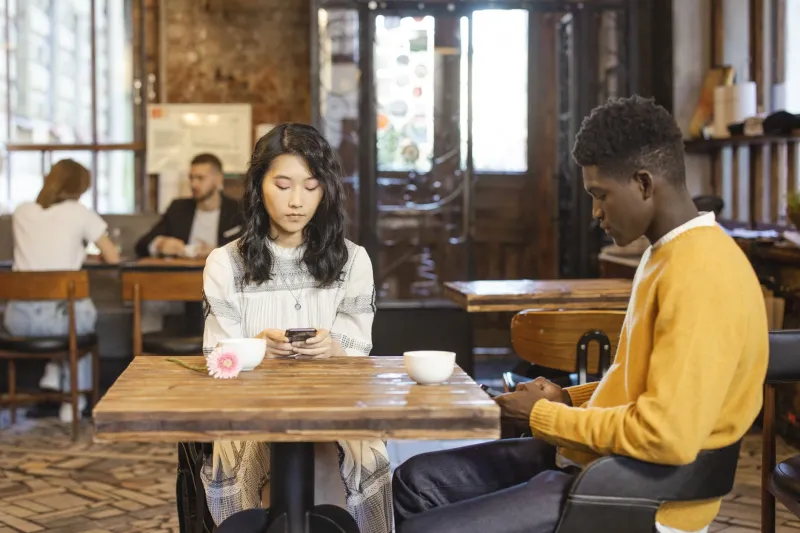
Let's set the scene. It's a Sunday afternoon. Your mom is in the kitchen making dal. Your phone is face-down on the couch because your Hinge notifications have been going off since 10 a.m. You have a date on Wednesday with someone whose last name your parents would absolutely Google. And you are not, under any circumstances, having this conversation today.
This is the opening scene of desi Gen-Z dating in America. And it plays out in apartments from Fremont to Flushing, from Sugar Land to Schaumburg, with the same particular brand of low-grade anxiety that no dating app has figured out how to swipe away.
The Double Life Is Real, And Exhausting
For a lot of South Asian Americans in their twenties, dating apps exist in a strange parallel universe that runs alongside their actual life. There's the life their parents know about — work, grad school applications, the occasional family function — and then there's the life on their phone, which involves a carefully curated profile, a roster of matches, and a level of emotional labor that would exhaust a therapist.
"My parents don't even know I'm on apps," says Deepika, 24, a first-generation Indian American living in the Bay Area. "My mom still thinks I'll just... meet someone at a family friend's house. Like it's 1987. I have a full dating life that she has zero idea about, and it's genuinely tiring to keep those two things separate."
The secrecy isn't just about avoiding awkward conversations. For many desi Gen-Z daters, it's about self-preservation. The community gossip networks are real, fast, and merciless. One wrong screenshot, one mutual connection who happens to know your cousin, and suddenly your dating life becomes a topic at someone's dinner table in a city you've never been to.
"Aunty networks are more efficient than any algorithm," says Rajan, 26, a Pakistani American in Chicago. "I matched with someone whose mom is friends with my mom's college friend. I found out three days later. It's a small world when you're brown."
The App Itself Is a Minefield
Even before you get to the parental anxiety, the apps themselves present a specific set of challenges for South Asian daters that the platforms were clearly not designed with in mind.
Colorism is rampant and largely unaddressed. Multiple South Asian women interviewed for this piece described patterns of being fetishized by non-South Asian matches or deprioritized within their own community based on skin tone. The preference filters that apps allow users to set have been widely criticized for enabling racial bias, and for desi daters, this plays out with painful specificity.
"I've had guys — desi guys — tell me I'm pretty 'for my complexion,'" says Meera, 23, a Tamil American in New York. "On a dating app. In 2024. And it's not just from outside the community. The colorism inside our own community is something I was not prepared to encounter on Hinge."
The apps also flatten cultural nuance in ways that create friction. A profile that lists "Indian" as a background collapses an enormous amount of regional, religious, linguistic, and class identity into a single word. Matching with another South Asian person doesn't guarantee cultural compatibility — it might just mean you both know what biryani is.
Deprogramming Takes Work
One of the more honest conversations happening in desi Gen-Z dating spaces — on Reddit, in group chats, on podcasts like Brown Girl Problems — is about the internalized stuff. The preferences and prejudices absorbed from family, community, and Bollywood that show up, uninvited, in how you swipe.
Preferences for lighter skin. Assumptions about caste. The reflexive discomfort when a match's family is from a different region or religion. The way certain last names trigger an automatic calculation before you've even read the bio.
"I had to actively interrogate why I was filtering the way I was filtering," says Ananya, 25, a second-generation Gujarati American in Atlanta. "Some of it was just preference. But some of it was stuff I'd absorbed from my parents and my community that I'd never actually examined. That process was uncomfortable. But it was necessary."
This kind of self-interrogation is increasingly common among desi Gen-Z daters who are trying to date consciously rather than just replicating the biases of the generation before them. It doesn't always go smoothly. But the fact that it's happening at all represents a genuine shift.
The 'Do They Get It?' Question
For South Asian Americans who date outside their community, there's a specific and exhausting calculation that runs in the background of every new relationship: do they actually get it?
Not just the food and the festivals — the stuff underneath. The guilt that comes with prioritizing yourself. The weight of your parents' immigration story. The way you exist in two cultural registers simultaneously and have to translate yourself constantly. The particular grief of loving a culture that the wider world sees as a punchline.
"I've dated non-desi people who were genuinely curious and made the effort," says Preethi, 27, a South Indian American in Seattle. "And I've dated desi people who had the same last name as me and still didn't understand what I was carrying. 'Do they get it' is less about background and more about emotional intelligence."
At the same time, there's something that happens in relationships between two South Asian Americans that doesn't require explanation — a shared grammar of experience that shows up in small moments. The way you both automatically take off your shoes at the door. The way a specific smell or song can pull you both to a kitchen in another time zone. The shorthand that doesn't need to be taught.
Redefining Love on Their Own Terms
What's emerging from all of this friction — the hidden apps, the aunty networks, the colorism, the self-interrogation, the cultural translation — is something genuinely new. Desi Gen-Z isn't rejecting love or relationships. They're rebuilding what those things look like from the ground up.
They're setting boundaries with parents that previous generations couldn't afford to set. They're having conversations about caste and colorism that were considered unspeakable at the family dinner table. They're choosing partners based on emotional compatibility rather than community approval — and increasingly, they're doing it out loud.
Some of them are bringing those partners home. Some of them are having the hard conversation with their parents and surviving it. Some of them are still hiding their phones on Sunday afternoons while the dal simmers in the kitchen.
All of it is part of the same story: a generation that was handed a set of rules about love that don't fit their lives, and is quietly, stubbornly, writing new ones.
The algorithm doesn't have a filter for that kind of courage. But it's out there, swiping anyway.