Thread by Thread: How South Asian Designers Are Rewriting the Rules of American Fashion
For decades, South Asian aesthetics in Western fashion followed a predictable and frankly exhausting pattern: a non-desi designer would "discover" block printing, or send models down a runway draped in something vaguely sari-adjacent, and the fashion press would lose its mind calling it exotic and innovative. Meanwhile, the actual South Asian artisans and designers who had been perfecting these techniques for generations got — at best — a footnote.
That era is not quite over, but something significant is shifting. A new generation of South Asian designers is planting flags in American fashion in a way that feels genuinely different from what came before. Not as a trend. Not as an aesthetic moment. As a permanent reorientation of who gets to define what American style looks like.
The New Guard and What They're Actually Doing
The names getting attention right now aren't following the old playbook of assimilation — softening their references to make Western audiences more comfortable. If anything, they're doing the opposite.
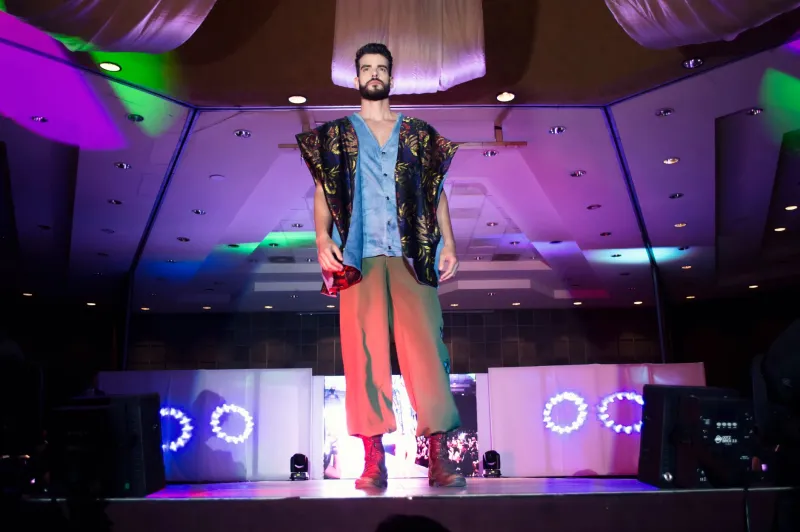
Designers like Priya Ahluwalia, Supriya Lele, and Naeem Khan have been chipping away at the mainstream for years, but the current moment feels like a critical mass is forming. New York Fashion Week has seen a noticeable uptick in South Asian designers presenting full collections — not capsule collaborations or one-off presentations, but proper runway moments that demand to be taken seriously.
What distinguishes this wave is how deliberately it engages with material culture. We're talking about chanderi silk from Madhya Pradesh being cut into deconstructed blazers. Kantha embroidery — a centuries-old running-stitch technique from Bengal — showing up on structured coats designed for a Chicago winter. Ajrakh block prints, traditionally made in Kutch and Sindh, reimagined as wide-leg trousers that would look at home in any SoHo boutique.
This isn't fusion for fusion's sake. It's a deliberate act of authorship.
Reclaiming the Symbols
Ask any South Asian woman who grew up in the US about the bindi moment of the late '90s and early 2000s, and you will get a very specific look. The same forehead dot that got kids teased in middle school hallways was simultaneously being worn by pop stars and festival-goers as a "boho" accessory. No credit to the culture. No context. Just vibes.
The designers making moves right now are acutely aware of that history, and they're responding to it with intention.
"I'm not interested in making my work palatable to people who want to wear the aesthetic without understanding the story," says one New York-based designer of South Indian heritage who recently showed at an emerging designers showcase in the city. "Every technique I use comes from somewhere specific. I want the customer to know that. I want it to matter."
This kind of radical contextualization is showing up everywhere — in brand storytelling, in lookbook photography, in the way collections are named and described. It's fashion with receipts. And American consumers, particularly younger ones, are responding to it.
The Retail Reality Check
Critical acclaim and runway buzz are one thing. Getting onto actual retail shelves — and staying there — is another conversation entirely.
The commercial pipeline for independent South Asian designers in the US remains genuinely difficult to navigate. Wholesale relationships with major department stores require production minimums that small independent labels often can't meet. The fast fashion machine has a long, ugly history of ripping off independent designers — and South Asian aesthetics have been particularly vulnerable to this, given how frequently their visual language gets absorbed into mass-market collections without attribution or compensation.
But there are cracks of light. Platforms like Rent the Runway and REVOLVE have begun actively courting South Asian-owned labels. Niche boutiques in cities with large diaspora communities — think Artesia in Los Angeles, Devon Avenue in Chicago, Jackson Heights in New York — have long been quiet incubators for South Asian fashion entrepreneurship, and some of those local success stories are now scaling nationally.
Direct-to-consumer has been the real game-changer, though. Brands like Kalki Fashion and Raw Mango have built US customer bases almost entirely through Instagram and targeted digital marketing, bypassing traditional retail gatekeepers entirely. The diaspora, it turns out, is an incredibly loyal consumer base when you actually make something for them.
What "American Fashion" Even Means Now
Here's the bigger cultural argument embedded in all of this: what does it mean to call something "American fashion" in 2024?
For most of the industry's history, that phrase has functioned as a shorthand for a very specific aesthetic lineage — sportswear, denim, minimalism, the occasional prairie moment. It was, by default, a white aesthetic framework with room for exactly as much cultural diversity as the gatekeepers decided to allow in any given season.
The South Asian designers making noise right now are implicitly — and sometimes explicitly — challenging that framing. America is the country where more than five million people of South Asian descent live and work and raise families and spend money on clothes. Why wouldn't American fashion reflect that?
"I think about this a lot," says Meera, a 31-year-old fashion buyer of Sri Lankan heritage based in Los Angeles. "When I see a South Asian designer on a New York runway, it doesn't feel like diversity programming to me. It feels like reality finally catching up to itself."
The Craft Question
One thread running through almost every conversation about South Asian fashion's American moment is craft — specifically, the extraordinary depth of textile and artisanal knowledge embedded in South Asian fashion traditions, and what happens to that knowledge as these brands scale.
Many of the most celebrated designers in this space are deeply committed to maintaining relationships with the artisan communities their techniques come from. This means slower production cycles, higher price points, and a business model that is explicitly anti-fast-fashion. It's a harder sell commercially, but it's also a more honest one.
The best South Asian fashion brands entering the American market aren't just selling clothes. They're selling a relationship to craft, to history, to the idea that what you wear carries meaning. In a market absolutely saturated with disposable trend content, that's a genuinely radical proposition.
The Runway Is Just the Beginning
The presence of South Asian designers on American runways is meaningful, but it's a starting point, not a destination. The real work is in building sustainable businesses, protecting intellectual property, mentoring the next generation of designers, and continuing to push back against the appropriation machine that has historically profited from South Asian aesthetics while excluding South Asian creators.
The designers doing this work know the runway moment is symbolic. What they're building thread by thread, collection by collection, is something more durable: a permanent place in the story of what American fashion is and who gets to make it.
And honestly? It's about time.