Group Chat Is the New Dining Room: How Desi Families Moved the Dinner Table to Their Phones
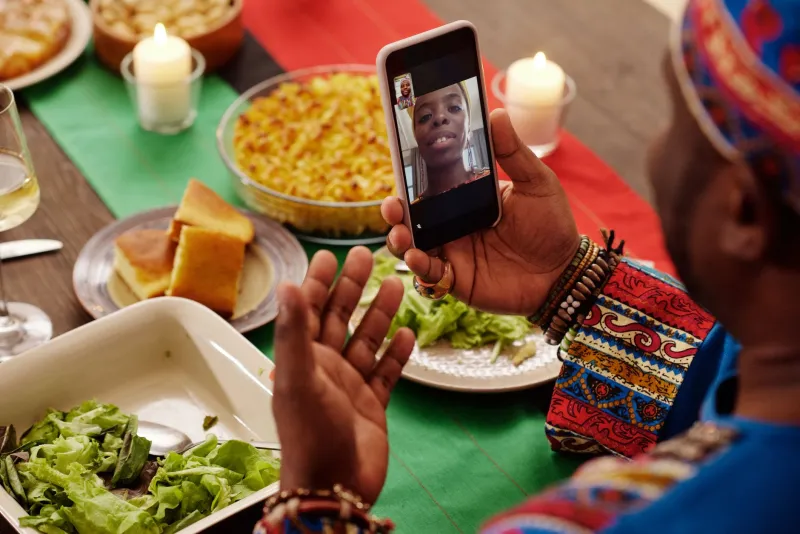
There's a particular kind of chaos that happens every Sunday around noon in Priya Nair's phone. Her mother in New Jersey sends a photo of dal tadka, steam still rising. Her maasi in Houston responds with a voice note — forty-five seconds of unsolicited opinions about whether the tempering looks right. Her cousin in Atlanta drops a laughing emoji. Someone's uncle, whose contact name is simply "Chacha 📞," sends a forwarded video of a completely unrelated news story. And just like that, without anyone sitting in the same room, the family has eaten together.
"It's ridiculous," Priya laughs. "But also? I'd be devastated if it stopped."
For millions of South Asian families scattered across the United States, the traditional dinner table — that physical anchor of daily life, argument, laughter, and connection — has been replaced, or at least seriously supplemented, by digital spaces that nobody officially designed for this purpose. WhatsApp groups with names like "Sharma Family 🌶️" and "THE REAL FAMILY CHAT (no drama)" have quietly become the most important rooms in the house. And the conversations happening inside them are more layered, more emotional, and more culturally loaded than most people are willing to admit out loud.
The Original Dinner Table Was Already Complicated
Let's be honest: the romanticized version of the Desi dinner table — everyone gathered, elders dispensing wisdom, food passed hand to hand — was never the full picture for diaspora families. Immigration scattered people before apps existed. Grandparents stayed behind. Cousins grew up on different continents. For a lot of second-gen kids raised in the US, the "family dinner" was often just their nuclear household of three or four people, with the extended family existing mostly as voices on expensive international phone calls.
What technology did wasn't destroy something perfect. It actually rebuilt something that distance had already fractured.
"My grandmother and I never had a dinner table relationship," says Arjun Mehta, 29, who grew up in suburban Ohio while his dadi lived in Ahmedabad. "But on WhatsApp? We talk every other day. She sends me pictures of what she cooked. I send her pictures of what I attempted to cook. She tells me I'm doing it wrong. It's the closest thing to sitting in her kitchen that I've ever had."
That's not a small thing. That's a relationship that didn't exist before, built entirely in a chat window.
The Food Photo as Love Language
If you want to understand how Desi group chats function as surrogate dinner tables, start with the food photos. They are relentless, they are blurry, they are often accompanied by zero context, and they are absolutely central to the whole operation.
Posting a photo of your meal in the family group chat is not bragging. It's an invitation. It's the digital equivalent of setting an extra plate. You're saying: look what I made, look what I'm eating, look how I'm doing. And the responses — the "wah wah," the recipe questions, the gentle criticism about whether the roti is round enough — are how the family says we see you, we're here.
Rekha Subramaniam, a cultural studies researcher based in Chicago who studies South Asian diaspora communities, describes it as "asynchronous togetherness." "Traditional communal eating is synchronous — you're all there at the same time," she explains. "What these digital spaces create is a kind of stretched-out version of that. The meal gets shared over hours or even days. Different family members respond when they can. But the emotional function is remarkably similar. You're still performing care through food."
Discord Entered the Chat
WhatsApp is the old guard — the aunties' domain, the forwarded-health-tip territory. But younger Desi families and friend groups are increasingly building their own digital kitchens on Discord, building servers with dedicated channels for recipes, music recommendations, rant spaces, and what one 24-year-old from Dallas described to us simply as "the channel where we yell about our parents."
Discord might seem like an unlikely space for South Asian cultural bonding, but it makes a certain kind of sense. It's organized, it's searchable, and critically, it allows for the kind of topic separation that a single WhatsApp thread cannot. You can drop a Carnatic music playlist in one channel and post a meme about desi aunties in another without your grandmother accidentally reacting to the wrong thing.
For second and third-gen diaspora communities, these servers have become spaces for a very specific kind of cultural processing — the kind that's hard to do in front of parents but necessary to do with people who get it. "It's where I figured out that a lot of my complicated feelings about being Indian-American weren't just mine," says Divya Krishnaswamy, 26, who moderates a South Asian diaspora Discord server with over 800 members. "Someone would post something about feeling like a guest in both cultures and forty people would respond in fifteen minutes. That doesn't happen at an actual dinner table."
What the Screen Can't Hold
None of this is without loss, and it would be dishonest to pretend otherwise.
There are things that happen at a physical table that a group chat cannot replicate. The way a grandmother's hands move when she rolls dough. The specific silence that falls when an elder is about to say something important. The smell of cardamom. The weight of sitting next to someone you love after a hard week, not saying anything, just being in the same room while food gets passed around.
Suma Pillai, 58, who immigrated from Kerala and now lives in northern Virginia, is grateful for the WhatsApp group that keeps her connected to her siblings back home and her kids in different states. But she's also clear-eyed about what it replaces and what it doesn't. "When my mother was dying, we were all on video call. We could see her. She could see us. But we couldn't hold her hand," she says quietly. "The chat is wonderful. But it is not the same as being there. It cannot be."
That grief is real. And it lives alongside the genuine connection that these digital spaces make possible. Both things are true at once.
The Rituals Are Still Rituals
What's striking, when you talk to Desi families across the country about their group chats, is how quickly digital spaces develop their own rituals. The Sunday food photo. The Eid message that someone always sends first. The birthday voice note that your dad records in one take and sends without listening back to it. The thread that goes silent for two weeks and then explodes with forty messages at 11pm for no discernible reason.
These aren't lesser versions of real rituals. They're new ones, built by and for people whose lives don't fit the geography their parents imagined. They're evidence that the desire for connection — that deeply South Asian impulse to gather, to feed each other, to know what everyone is eating and how everyone is doing — doesn't disappear when the circumstances change. It adapts. It finds the available container and fills it.
The dinner table moved to a phone screen. The conversation got louder, weirder, and more emoji-heavy than anyone planned. And somehow, across time zones and generations and the specific madness of diaspora life, the family is still sitting down together.
Somebody's chacha is still sending that forwarded video. And honestly? That's kind of everything.