Press Start, Beta: What Your Kid's Gaming World Is Actually Trying to Tell You
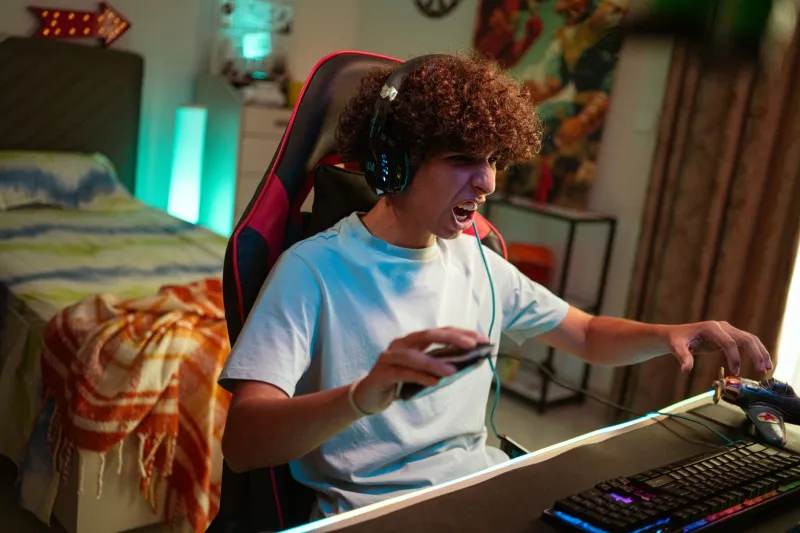
Let's set the scene. It's 11 PM on a Friday. Your teenager is in their room, headset on, talking to what sounds like six different people at once. You knock, crack the door open, and ask who they're talking to. They say, "My friends." You ask where these friends are. They say, "Everywhere." You close the door, shake your head, and wonder when exactly you lost the plot.
Here's the thing though: you haven't lost the plot. You're just reading the wrong genre.
Because what's happening in that room — in those Discord servers, those gaming lobbies, those late-night streams — is something that would actually look very familiar to you if you knew where to look. It's community. It's language. It's culture being passed around and renegotiated in real time, just not over chai and not in your living room.
The Server Your Kid Built Is More Than a Lobby
Discord, for anyone who hasn't been dragged into it yet, is basically a messaging and voice app that started in gaming and has since taken over the entire internet. Teenagers use it the way older generations used neighborhood hangouts — except the neighborhood is global, always open, and has its own rules, its own jokes, and its own internal hierarchy.
What's interesting — and what most Desi parents completely miss — is that a huge number of South Asian Gen-Z kids have built or joined Discord servers that are specifically, intentionally, unmistakably desi. There are servers organized around South Asian gaming communities, servers where people casually switch between English and Hindi or Tamil or Punjabi mid-sentence, servers where someone will drop a meme about their mom's reaction to a bad grade and thirty people from three different countries will respond with the same exact story.
That's not nothing. That's actually a form of cultural archiving that your kid's school curriculum absolutely will not provide.
Language Doesn't Die — It Migrates
One of the things that gets lost in the "gaming is a waste of time" conversation is how much language actually lives in these spaces. Not formal language, not the kind you'd hear in a Bollywood drama or a classical music lesson, but the lived, breathing, code-switching kind that diaspora kids navigate every single day.
Desi gamers will slide between "bhai, cover me" and "dude, what was that" without even registering the shift. Inside jokes will build up around shared cultural references — a streamer's mom walking into frame during a live session, a team name that's a pun only people who grew up with a certain kind of Desi household would catch. Slang from back home gets remixed with internet speak and something genuinely new emerges.
This is what linguists call a contact language, and it's been happening in immigrant communities forever. The difference now is that it's happening at scale, across borders, in real time, and your kid is right in the middle of it.
The Streamers You've Never Heard Of
If you want to understand what your kid is actually watching, you need to know about the wave of South Asian streamers who have built serious audiences in the US and globally. These aren't just people playing video games. They're creators who bring their whole cultural selves into the stream — talking about immigrant family dynamics, navigating expectations, cracking jokes that only make sense if you grew up with a certain kind of pressure.
For Desi kids in America who often feel like they're performing two different versions of themselves — one for school, one for home — watching a streamer who just gets it without explanation is genuinely meaningful. It's representation, but the casual kind. The kind that doesn't announce itself. The kind that just exists and says, quietly, you're not the only one.
Parents who write this off as screen addiction are missing the part where their kid is finding a mirror that the broader culture hasn't really offered them yet.
Where Desi Values Show Up Anyway
Here's the irony that doesn't get talked about enough: a lot of the values Desi parents care most about — loyalty, community, showing up for your people, respecting those who've put in the work — are deeply embedded in gaming culture too.
Guild hierarchies. Team coordination. The unspoken rule that you don't abandon your crew mid-match. The way experienced players mentor newer ones without making a big deal of it. These aren't foreign concepts to kids raised in South Asian households. They're actually pretty familiar. They've just been translated into a different context.
The rigidity that sometimes makes Desi family dynamics complicated gets softened in gaming spaces, but the underlying values — show up, be reliable, earn your place — aren't so different from what your parents were trying to teach you, and what you're trying to teach your kids.
What Parents Are Actually Missing
The conversation most Desi parents are having with their kids about gaming goes something like: "You're wasting time, you need to study, what is the point of this." Which, fair, as a reflex. But it skips over some genuinely important questions.
Who are your kid's actual friends in these spaces? What are they building together? What does your kid talk about when they're with people who aren't going to judge them? What version of themselves are they exploring?
Gaming spaces, for a lot of Desi Gen-Z kids, are some of the only places they get to just exist without negotiating identity. They don't have to explain why they went home right after school. They don't have to translate a reference. They don't have to be the representative of an entire culture to a room full of people who've never thought about it.
That kind of release isn't frivolous. That's actually really important for a kid who's carrying a lot.
So What Do You Do With This?
You don't have to become a gamer. You don't need to learn what a ranked match is or pretend to care about whoever your kid is currently obsessed with on Twitch. But you could ask a few different questions than the ones you've been asking.
Instead of "how long have you been on that thing," try "who were you playing with tonight." Instead of "you need to stop wasting time," try "what's your team like." You might be surprised what comes back.
Your kid's Discord server is not the enemy of your culture. In a lot of ways, it's carrying pieces of it forward in a language you haven't learned yet. That doesn't make it less real. It just means there's a translation happening, and you still have time to ask what it says.