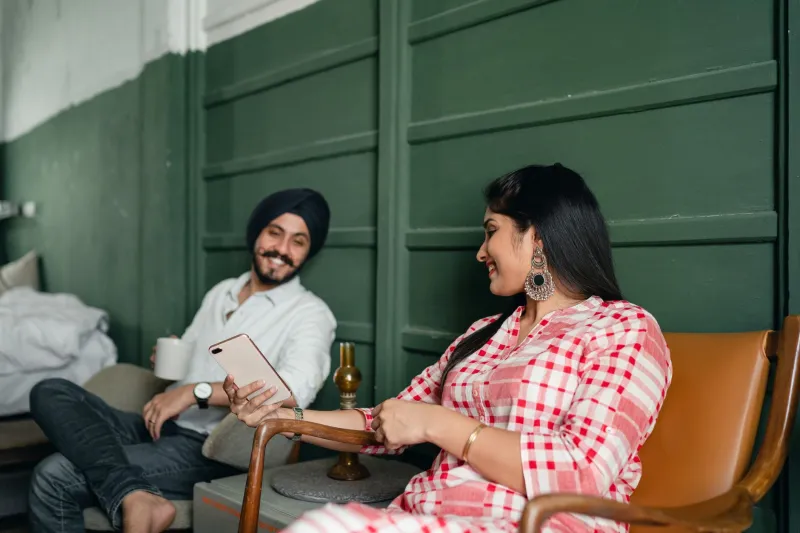
Two Faces, One Person: How Desi Americans Are Finally Deciding When to Code-Switch — And When to Stop

There's a version of Priya that shows up to her Chicago law firm every Monday morning. She speaks in crisp, measured sentences. She laughs at the right moments. She keeps her lunch — usually leftovers her mom packed, something deeply turmeric-forward — in a sealed container so the break room doesn't become A Whole Thing. And then there's the Priya who exists literally everywhere else: loud, opinionated, dropping Hinglish mid-sentence, using her hands like punctuation.
For a long time, she thought this was just called "being professional."
"It took me until I was 30 to realize I wasn't code-switching to fit in," she says. "I was code-switching to disappear."
This is the conversation happening quietly — and increasingly not-so-quietly — across Desi America right now. Code-switching, the practice of adjusting your language, tone, mannerisms, and even personality depending on your audience, has long been treated as a survival skill for people of color navigating predominantly white spaces. For South Asian Americans specifically, it's been layered on top of an already complex identity stack: first-gen pressures, immigrant family expectations, cultural pride, and the particular exhaustion of being perpetually perceived as "almost but not quite" American.
But something's shifting. And it's worth paying attention to.
The Many Modes of a Desi Life
If you grew up South Asian in the US, you already know the modes. There's Work Mode: polished, deferential, careful not to be "too much." There's Family Mode: reverting to childhood dynamics the second you walk through your parents' door, suddenly agreeing that yes, you should call your cousin more often. There's Friend Mode, which splinters further depending on whether those friends are Desi or not. And then there's the dating scene, which deserves its own PhD thesis entirely.
Naveen, a 27-year-old software engineer in the Bay Area, describes it as living inside a series of nested apps. "Each context is a different interface," he says. "And you're constantly switching between them, trying to make sure none of them crash."
The metaphor is very on-brand for him, but the underlying experience is universal. Research on identity negotiation consistently shows that people from minority cultural backgrounds expend significantly more cognitive energy managing how they're perceived across different social environments. It's not just exhausting — it can quietly chip away at a person's sense of who they actually are.
For Desis, this gets amplified by a specific cultural expectation: that you should be able to move fluidly between worlds without complaint, because that's what your parents did, and look how far they got.
When the Skill Becomes the Cage
Here's the thing nobody really talks about — code-switching works. At least in the short term. The Desi kid who learned to flatten their accent got the internship. The one who stopped bringing "weird" food to school lunch survived middle school with fewer scars. The professional who mastered the art of strategic invisibility got the promotion.
But survival strategies have a shelf life.
Psychologists who study identity and belonging have documented what's sometimes called "identity fragmentation" — the psychological cost of maintaining too many separate selves for too long. It shows up as chronic low-grade anxiety, a persistent sense of being a fraud, and an inability to feel fully comfortable anywhere. Not at work, where you're performing. Not at home, where the performance is different but equally exhausting. Not even alone, because you've lost the thread of who you are when nobody's watching.
Simran, a 31-year-old therapist in New York who works primarily with South Asian clients, sees this constantly. "A lot of my clients come in thinking they have an anxiety problem or a career problem or a relationship problem," she says. "And what they actually have is an identity problem. They've been so good at adapting that they've forgotten what they're adapting from."
The dating context is particularly revealing. Multiple Desi Gen-Z women interviewed for this piece described a specific exhaustion around romantic relationships: the calculation of when to introduce the full, unfiltered version of themselves versus the version that was easier to explain. One woman described spending an entire first date with a non-Desi guy carefully managing his potential confusion about her family dynamics, her food preferences, her relationship to religion. "By the end," she said, "I was so tired that I couldn't figure out if I actually liked him or not."
The Generation That's Calling It Out
What's different now is that younger Desis are naming this dynamic explicitly — and increasingly refusing to play along.
On TikTok and Instagram, South Asian creators are building massive followings precisely by refusing to code-switch for their audiences. They're not explaining their culture, they're just living in it. They're making content in Hinglish, Punjabi, Tamil, Telugu — and not adding subtitles for people who don't get it. They're talking about izzat and rishtas and desi aunty culture without pausing to define terms. The audience that's meant to find them finds them.
This isn't just content strategy. It's a philosophical stance.
"I spent my whole childhood translating myself," says Arjun, a 24-year-old content creator based in Houston. "My parents translated themselves so I could have a better life. I'm not doing it anymore. If you want to understand me, come to where I am."
The pushback is real, of course. Some professionals worry that opting out of code-switching entirely is a privilege not everyone can afford, particularly in industries or regions where South Asian representation is still thin. There's a legitimate argument that the system hasn't changed enough yet for everyone to stop adapting to it.
But the more nuanced position — the one gaining traction — isn't "never code-switch." It's "code-switch consciously, when you choose to, not out of fear."
Choosing Your Switches
There's a version of code-switching that's actually just communication competence: adjusting how you speak to a child versus a colleague, being more formal in a job interview than at a barbecue. That's not erasure. That's just being a functioning human.
The problem is when the switch gets flipped automatically, reflexively, out of a deep-seated belief that your authentic self is the problem. That's where it stops being a skill and starts being a wound.
Simran, the therapist, talks about this distinction with her clients constantly. "I ask them: are you adjusting your communication style, or are you hiding who you are? Those are very different things. One is a tool. The other is a survival response that was useful once and might not be anymore."
Priya, the Chicago attorney, says she's been doing a slow, ongoing audit of her own switches. Some she's kept — she genuinely prefers a certain register at work, and that's fine. Others she's started quietly dismantling. She brings her lunch without apology now. She references her family in conversations without pre-emptively managing anyone's reaction. Small things. But they add up.
"I'm not trying to make a statement," she says. "I'm just trying to be one person. That shouldn't be radical. But for a lot of us, it kind of is."
For Desi Americans navigating this right now, maybe that's the only real takeaway: you get to decide which version of yourself walks into the room. All of them are real. But you're the one holding the remote.