You Didn't Plan It, But You're All Wearing the Same Thing: The Unwritten Dress Code of the Desi Wedding
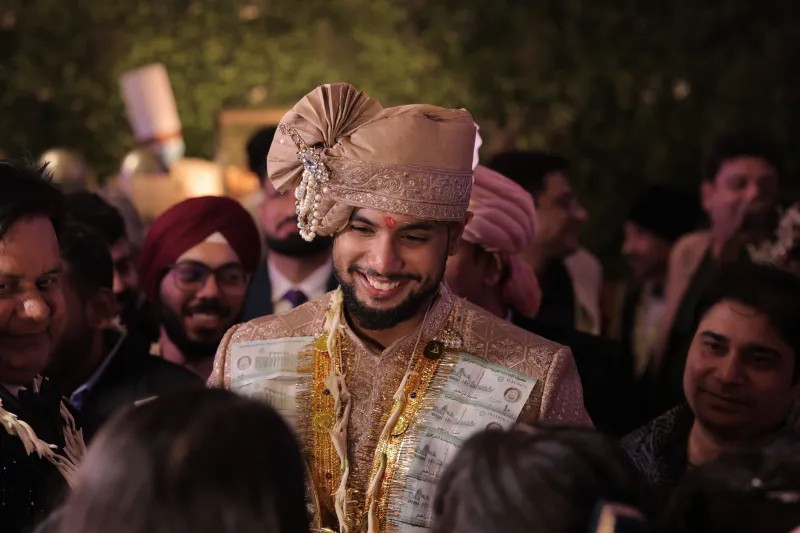
You walk into the banquet hall. The chandeliers are doing the most. The dhol is already too loud for the hour. And without a single coordinating email, every woman in the room has somehow landed in a jewel-toned lehenga, a statement neckpiece, and heels she'll regret by the third hour of standing on marble. Nobody planned this. Nobody had to.
The Desi wedding dress code is one of the most elaborate unspoken systems in South Asian culture — a set of rules passed down not through instruction but through osmosis, observation, and the occasional devastating comment from a relative who makes it sound like a compliment. If you grew up in a South Asian household, you absorbed these rules the way you absorbed everything else: by watching, by getting it wrong once, and by never getting it wrong again.
The Rules Nobody Wrote Down (But Everybody Knows)
Let's start with the big one: don't wear white. Don't wear red if you're not the bride. Don't wear black unless you're trying to start a conversation you didn't ask for. Don't show up in something too casual — and "too casual" is defined entirely by whoever's looking at you. These aren't posted anywhere. There's no FAQ on the wedding website. But violate any of them and you will feel it, in real time, through a look from across the room that communicates everything without a single word.
The color hierarchy at a South Asian wedding is its own kind of science. Brides get red, or ivory, or some bridal variation thereof. The groom's mother is usually in something that reads "important but not competing." The bride's mother is in something that says "I paid for this and I need everyone to know I have taste." Guests are expected to be festive, polished, and entirely non-threatening to the bride's visual dominance. It's a delicate ecosystem.
Then there's the jewelry question. Showing up with no jewelry — or worse, minimal jewelry — is treated less like a style choice and more like a cry for help. "She didn't even wear earrings" is a sentence that has been spoken at more Desi weddings than anyone wants to admit. The expectation isn't just that you accessorize. It's that you visibly tried.
How These Rules Actually Get Passed Down
Here's the thing: nobody sits a young Desi girl down and explains the wedding dress code. It happens in fragments. It's your mom holding up a salwar in the store and saying "that's too plain for a wedding." It's your auntie commenting on a cousin's outfit photo before the event even happens. It's the group chat that gets activated three weeks before the function where someone asks "what are we all wearing" — and suddenly there's a negotiation happening in real time to make sure nobody shows up in the same color as someone else important.
For Desi Americans specifically, this is where it gets layered. You're navigating the original set of rules that came with your family's culture — whether that's Pakistani, Indian, Bangladeshi, Sri Lankan — and then you're adding the American context on top of it. Maybe the wedding is in a hotel in New Jersey and the vibe is slightly different from a wedding back home. Maybe half the guest list is non-South Asian and you're suddenly aware of being seen through two different sets of eyes at once. The dress code doesn't disappear in diaspora. It just gets more complicated.
The Sidelong Glance Is Its Own Language
Enforcement of these rules is almost never direct. Nobody is going to walk up to you and say your outfit is wrong. Instead, there's a whole grammar of nonverbal feedback that Desi wedding guests are fluent in. The slow scan from head to toe. The "oh, that's interesting" with a pause that does a lot of heavy lifting. The compliment that's technically a compliment but lands with a weight you can't quite explain.
This is part of what makes the unspoken dress code so effective — and so exhausting. Because you can't argue with a look. You can't defend yourself against an implication. You just absorb it and recalibrate for the next function.
And there's always a next function.
Why "Just Comfortable" Is Basically a Cultural Crime
One of the most persistent tensions at Desi weddings in America is the idea that you might want to just... be comfortable. Wear something you can actually move in. Skip the heels. Go light on the jewelry because you're going to be standing for six hours and you have a long drive home.
This is treated, in many Desi circles, as a kind of betrayal. Not of the bride and groom necessarily, but of the occasion itself. South Asian weddings are understood to be performances — not just for the couple, but for everyone present. You are a participant in the visual spectacle, not just a witness to it. Dressing down isn't just a personal choice; it reads as a commentary on how much you care.
Which is a wild amount of pressure to put on a pair of shoes.
Gen-Z Is Quietly Rewriting the Script
Here's where it gets interesting. The younger generation of Desi Americans — the ones who grew up with Instagram mood boards and a genuinely global sense of what fashion can look like — are starting to show up to weddings in ways their aunties did not see coming.
We're talking fusion outfits that blend traditional silhouettes with streetwear elements. We're talking men in kurtas paired with sneakers, not because they forgot dress shoes, but because that's the look they wanted. We're talking women in co-ord sets and jumpsuits that are clearly dressy but clearly not a lehenga. And yes, occasionally, someone shows up in something that makes the aunties visibly recalibrate.
The interesting part is that this isn't always rebellion for rebellion's sake. A lot of Gen-Z Desis are deeply invested in their culture — in the music, the food, the rituals, the meaning behind the ceremony. They're not opting out of the wedding. They're opting out of the idea that their outfit has to be a performance of compliance. There's a difference.
Some families are rolling with it. Others are not. The group chat negotiations are getting more complicated.
The Part Nobody Talks About
Underneath all of this is something worth naming: the dress code is also about belonging. Showing up in the right outfit, in the right colors, with the right amount of jewelry is a way of signaling that you understand the culture, that you respect the occasion, that you are a full member of this community. Getting it wrong — even accidentally — can feel like being marked as an outsider in a space that's supposed to be yours.
For second and third generation Desi Americans, that tension is real. You want to belong to this world. You also want to belong to yourself. And sometimes those two things are wearing very different outfits.
Maybe the next generation figures out how to hold both. Or maybe they just show up in whatever they want and let the sidelong glances land where they will. Either way, the wedding starts when it starts. The food will be incredible. And somehow, inexplicably, half the room will still be in the same shade of magenta.